
West Virginia DMV Motorcycle Practice Test 20
- Questions25
- Correct to pass20
- Passing score80%
- Minimum age16 years
-
1. How can loose spokes be found on a spoked wheel?
Show answer
Answer B: By tapping each spoke and listening for a dull sound instead of a clear ring
A correctly tensioned spoke rings when tapped, while a loose one gives a flat, dull note that stands out from the rest of the wheel.
-
2. What does a West Virginia motorcycle instruction permit allow?
Show answer
Answer A: Riding during daylight hours without passengers
The West Virginia motorcycle instruction permit allows riding on public roads during daylight hours only, and no passenger may be carried.
-
3. A bicyclist in the bike lane ahead of you signals and starts to move left toward the turn lane. What should you do?
Show answer
Answer A: Slow down and let the rider move across
A bicyclist who needs to leave the bike lane to turn left is changing lanes like any driver, and following traffic should make room.
-
4. A rectangular red sign with the white words WRONG WAY means that
Show answer
Answer C: the driver is already traveling against the legal flow and must not continue
The wrong way sign uses a white legend and border on red and addresses a driver who has entered a ramp or one-way roadway in the wrong direction, who should stop and turn around safely.
-
5. You spot a deep pothole that the riders behind you will not be able to see until it is too late. What is the usual way to warn them?
Show answer
Answer B: Point at it with a hand or a foot on the side it lies on
Pointing at the hazard on the correct side tells the riders behind both that something is there and where in the lane it is.
-
6. Why is a wet road at night harder to read than the same road in daylight?
Show answer
Answer A: The wet surface reflects light away and swallows the lane markings
A film of water sends your headlight beam onward instead of back to you, so lines, edges and people in dark clothing almost disappear.
-
7. How is a wheel bearing checked during an inspection?
Show answer
Answer A: Raise the wheel clear of the ground and rock it side to side to feel for play
A worn bearing shows itself as side to side play in a raised wheel, and it may also feel rough or notchy when the wheel is spun.
-
8. You are leaving a freeway at an exit that has a deceleration lane. Where should you slow down?
Show answer
Answer C: After you have moved fully into the exit lane
Braking in a through lane surprises the traffic behind you, so you move into the exit lane at highway speed and then slow down inside it.
-
9. As a center two-way left-turn lane reaches an intersection, the markings change into a single left-turn lane. What does that mean for you?
Show answer
Answer D: From that point it serves one direction only, so use it just to turn left
Where the shared lane becomes a marked turn bay it belongs to one direction of travel, and only vehicles making that left turn may occupy it.
-
10. Under West Virginia's handbook glossary, what is the maximum horsepower a vehicle's independent power source may produce for that vehicle to still be classified as a moped?
Show answer
Answer B: Two horsepower
The handbook defines a moped as having an independent power source providing a maximum of two horsepower, along with foot pedals for pedaling.
-
11. A pedestrian is waiting to cross ahead of you and you have slowed down. What helps most?
Show answer
Answer D: Making eye contact, so that you both know you have seen each other
Eye contact confirms that you have seen each other; waving someone across can send them into the path of another vehicle.
-
12. In a work zone the temporary lane lines conflict with the old lines still visible on the pavement. Which do you follow?
Show answer
Answer C: The temporary markings, which show the current traffic pattern
Temporary markings define the traffic pattern in force, and the old lines are simply the layout that no longer applies.
-
13. What does a light drag of the rear brake do during a slow, tight turn?
Show answer
Answer C: It steadies the motorcycle and smooths out the power reaching the rear wheel
Working the rear brake against a slipping clutch takes the jerkiness out of the drivetrain and holds the machine steady through the turn.
-
14. The engine has warmed up and idles smoothly. What should be done with the choke?
Show answer
Answer C: Turn it off
A warm engine running on a rich mixture wastes fuel, runs poorly and can foul the spark plugs, so the choke is closed once it is no longer needed.
-
15. A bike lane on your right is marked with a dashed line for the last stretch before the corner. What does that dashed section allow you to do?
Show answer
Answer D: Merge into the bike lane after checking, and turn right from there
The dashed section is where drivers are meant to merge into the bike lane before turning, which puts cyclists behind the vehicle instead of beside it.
-
16. Just before the front wheel reaches an obstacle, what should you do with the throttle?
Show answer
Answer C: Roll it on slightly to lighten the front end
A small amount of throttle shifts weight rearward and lightens the front wheel so it rides over the obstacle more easily.
-
17. For an alert driver, about how long is the reaction time once a hazard has been recognized?
Show answer
Answer A: About three quarters of a second
Reaction alone takes roughly three quarters of a second for an alert driver, and perception takes about as long again, so a second and a half of travel is added before the brakes bite.
-
18. What is a driver being warned about here?
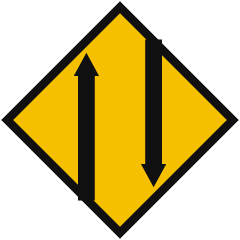
Show answer
Answer B: The pavement ahead carries vehicles traveling in the opposite direction
Beyond this point vehicles come the other way on the same pavement, which commonly happens where a one-way section or a separated stretch comes to an end.
-
19. Why should the leader of a group check the mirrors regularly?
Show answer
Answer B: To see whether the group is still together and adjust the pace if not
The leader is the only rider who can see the whole formation, and slowing slightly is the usual way to gather a group that has strung out.
-
20. What should a driver expect a short distance beyond this sign?
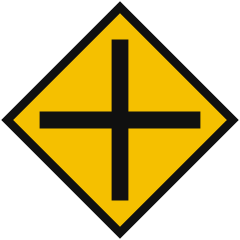
Show answer
Answer C: Another road crossing the one being traveled
Traffic may enter or cross from either side at the intersection ahead, so the driver should ease off, cover the brake and check both approaches.
-
21. You come up behind a bicyclist who is descending a steep hill in the middle of the traffic lane. What should you take into account?
Show answer
Answer D: The rider may be moving at close to the speed of the traffic
A bicycle can reach the speed of traffic on a descent, so there is little to gain from a pass and the rider needs the whole lane to steer around surface hazards.
-
22. What most often leads to an engine seizure on a motorcycle?
Show answer
Answer A: Loss of engine oil or coolant, so the moving parts overheat and grip
Seizure is normally a lubrication or cooling failure, which is why oil level and coolant are part of every pre-ride check and why a rising temperature reading deserves attention.
-
23. You are following another vehicle down a long, steep grade. What should you do about the gap?
Show answer
Answer D: Make it longer, because both of you need more room to stop
Everything takes longer to stop on a downgrade, including the vehicle ahead, so the gap that works on the flat is no longer enough.
-
24. What is the safest way to pass a bicyclist on a road with two lanes going your way?
Show answer
Answer D: Change lanes completely, as you would for a car
A bicycle is entitled to the room a vehicle needs, and moving into the next lane gives the rider space to swerve around a drain or a pothole.
-
25. School warning signs use which background and legend colors?
Show answer
Answer A: A black legend and border on a fluorescent yellow-green background
School warning signs carry a black legend and border on a fluorescent yellow-green background, a shade chosen so they stand out from ordinary yellow warning signs.