
West Virginia DMV Motorcycle Practice Test 16
- Questions25
- Correct to pass20
- Passing score80%
- Minimum age16 years
-
1. You have shut the engine off with the kill switch because the throttle stuck open. What comes next?
Show answer
Answer D: Keep the clutch in, brake to a stop off the road, and find the cause
With the engine off and the clutch pulled in the motorcycle is only coasting, so brake to a stop clear of traffic and inspect the throttle cable and grip before restarting.
-
2. Your navigation device tells you to turn where a road sign says the turn is closed. What should you do?
Show answer
Answer B: Follow the signs and what you can see
A device works from stored data that can be out of date, while signs and the road in front of you show the situation now, so the road wins every time.
-
3. You are waiting inside the intersection to turn left when your light turns red. What should you do?
Show answer
Answer A: Complete the turn as soon as the way is clear
Once you have legally entered the intersection you should clear it as soon as the oncoming traffic has stopped, rather than sit in the path of cross traffic.
-
4. How should you handle a prescription or over the counter medicine before driving?
Show answer
Answer D: Read the label and ask a pharmacist or doctor whether it affects driving
Many common medicines, including allergy and cold remedies, cause drowsiness or slowed reactions, and the label or a pharmacist can tell you whether driving is safe.
-
5. Two vehicles meet on a steep, narrow mountain road with no room to pass. Which driver should back up?
Show answer
Answer C: The driver heading downhill, who has more control while reversing
On a narrow mountain road the vehicle facing downhill yields, because backing uphill gives better control than reversing down a grade.
-
6. Which single event causes the largest share of crashes between a motorcycle and another vehicle at intersections?
Show answer
Answer B: A vehicle turning left across the path of an oncoming motorcycle
The classic motorcycle intersection crash is an oncoming driver who turns left across the rider's path, usually after failing to see the motorcycle or misjudging its speed.
-
7. You are on a city street with two lanes in your direction, cars parked along the curb and driveways every few yards. Which lane is usually safer?
Show answer
Answer B: The lane farther from the curb, away from opening doors and vehicles pulling out
Most of the hazards on such a street come from the curb side, so the inside lane gives you more space and more time to react.
-
8. During the tire check you find a nail driven into the rear tire. What should you do?
Show answer
Answer D: Have the tire repaired or replaced before the motorcycle is ridden
A punctured motorcycle tire can lose air suddenly, and a motorcycle has no second tire on that end to hold the machine up.
-
9. What does a posted speed limit sign represent?
Show answer
Answer B: The maximum speed permitted under ideal conditions
A speed limit is an upper limit that assumes good weather, good visibility and light traffic, so the safe speed is often lower than the posted figure.
-
10. You are stopped in a line of traffic waiting at a red light. What is the safest way to wait?
Show answer
Answer A: Stay in first gear, keep watching the mirrors and leave a way out
A vehicle approaching from behind may not stop in time, and staying in gear with a gap ahead lets the rider move out of the way.
-
11. A small plaque mounted under this sign shows a numeral such as 2 or 3. What does that numeral report?

Show answer
Answer A: How many sets of tracks the crossing carries
The plaque states the number of tracks at that location, which is a warning that a second train may be running on another track behind the first.
-
12. The traffic signal is green, but the crossing lights on the tracks inside the intersection begin to flash. What must you do?
Show answer
Answer C: Stop clear of the tracks and wait, even though the signal is green
Active crossing warning devices outrank the green indication, so you stop short of the rails and wait until the warning stops.
-
13. May you stop in the striped triangle that separates an exit ramp from the freeway lanes?
Show answer
Answer A: No, it is not a lane and stopping there is dangerous
The striped gore area is not a travel lane or a shoulder, and a vehicle stopped there sits directly in the path of drivers correcting a late exit.
-
14. When should a passenger get on the motorcycle?
Show answer
Answer D: After the engine has been started and the operator is ready
Mounting after the engine is running and the operator is settled keeps the motorcycle stable and spares the operator a long balancing act with the extra weight aboard.
-
15. Your right-turn lane shows a green arrow while the through lanes face a red ball. What does that mean?
Show answer
Answer C: Only the right turn is allowed, and it is protected while the arrow lasts
A green arrow gives a protected movement in that direction only; the red ball still stops the through traffic in the other lanes.
-
16. You are approaching the entry of a modern roundabout. Who must you yield to?
Show answer
Answer C: Traffic already circulating in the roundabout, which approaches from your left
Traffic in a United States roundabout circulates counterclockwise, so drivers entering must look left and yield to vehicles already in the circulating roadway.
-
17. A car is passing you on a two lane road. Which lane position is generally best while it goes by?
Show answer
Answer A: The center portion of your lane
The middle of the lane keeps distance from the passing vehicle and its mirrors while leaving room on the other side if the rider needs it.
-
18. A bicycle symbol topped by two chevrons is painted in the middle of a travel lane. What does that marking indicate?
Show answer
Answer D: Bicyclists share the lane with motor vehicles and may ride away from the curb
A shared lane marking shows drivers where bicyclists are likely to ride in a lane used by both bicycles and motor vehicles.
-
19. You see brake lights several vehicles ahead of you in your lane. What is the best first step?
Show answer
Answer C: Ease off the gas and cover the brake pedal
Reacting to the trouble several vehicles ahead, rather than waiting for the car in front, cuts your reaction time and warns the driver behind you.
-
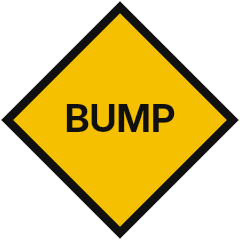
20. Why does this warning matter more on a motorcycle than in a car?
Show answer
Answer B: Because a sudden jolt can unsettle a two-wheeled machine and the rider can lose control
A jolt can push a motorcycle off line or lift a wheel, so a rider slows early, comes slightly off the seat and keeps a relaxed but firm hold on the handlebars.
-
21. Where in the United States may a motorcycle ride between lanes of traffic?
Show answer
Answer C: Only where a state has specifically authorized it
Riding between lanes is prohibited in most states and permitted only where a state law expressly allows it, so a rider must know the rule for the state being ridden in.
-
22. Why does a motorcycle feel less stable at very low speed when a passenger is aboard?
Show answer
Answer B: The passenger's weight sits high and to the rear, so balance is easier to upset
A second person adds mass above and behind the rear axle, so slow speed maneuvers such as pulling away, walking pace turns and stops demand more care.
-
23. Alcohol is classified as which kind of drug?
Show answer
Answer B: A depressant that slows the central nervous system
As a depressant, alcohol slows the brain and nervous system, which lengthens reaction time and dulls the coordination that driving depends on.
-
24. Why does a passenger often feel the cold sooner than the rider on a long ride?
Show answer
Answer B: A passenger sits still and does not have the fuel tank to shelter behind
The rider has a screen or a tank to break the wind and is busy operating the machine, while a passenger sits exposed and inactive and chills faster.
-
25. Why are pedestrians and cyclists a special risk on unlit streets at night?
Show answer
Answer A: Dark clothing can make them invisible until they are very close
A person in dark clothing reflects almost no light and may not appear until they are inside your stopping distance, so cut your speed where people may be about.