
West Virginia DMV Permit Practice Test 8
- Questions25
- Correct to pass19
- Passing score76%
- Minimum age15 years
-
1. At how many points does the West Virginia DMV send a driver a letter of caution?
Show answer
Answer B: 6 points or more
West Virginia sends a letter of caution once a record reaches six points, well before the suspension threshold.
-
2. You are the first driver on a road just after a storm. What should you plan for?
Show answer
Answer B: Branches, mud and other debris hidden around the next bend
Storm debris lands where nobody has cleared it yet, often just beyond a curve or a crest, so reduce speed and look much further ahead.
-
3. A sign on a freeway restricts trucks to the two right-hand lanes. What should a car driver expect in those lanes?
Show answer
Answer A: More heavy vehicles and slower changes of speed
A truck lane restriction concentrates heavy vehicles on the right, and those vehicles accelerate, brake and change lanes far more slowly than cars.
-
4. On what type of West Virginia roadway is a low-speed vehicle legally allowed to operate, aside from private roads?
Show answer
Answer D: Public roads and streets within a municipality where the posted speed limit is not more than 25 miles per hour
The handbook's glossary limits low-speed vehicles to private roads or public roads and streets within a municipality's corporate limits where the speed limit is not more than 25 miles per hour.
-
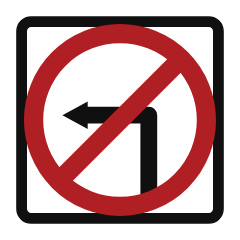
5. No plaque stating days or hours accompanies this sign at the intersection. When does the restriction apply?
Show answer
Answer D: At all times, since nothing limits it to particular periods
A regulatory restriction runs continuously unless a supplemental plaque states the days or hours during which it applies.
-
6. A large X with the letters R and R beside it is painted across your lane. What does it mean?
Show answer
Answer A: A railroad crossing lies a short distance ahead
The pavement marking repeats the advance warning for a grade crossing, and it is used on paved approaches where speeds are high or where gates are installed.
-
7. About how much alcohol can the body eliminate per hour?
Show answer
Answer A: About one standard drink
The liver removes alcohol at a nearly fixed rate of roughly one standard drink per hour. Drinking faster than that raises the blood alcohol level, and nothing speeds the process.
-
8. In most states, how far before a turn must your signal already be on in city traffic?
Show answer
Answer B: At least 100 feet, roughly the length of six or seven cars
Most states require the signal for at least 100 feet before a turn in city driving, which gives drivers behind you time to react before you slow; several require more at higher speeds.
-
9. You are stopped in traffic at a red light when an ambulance comes up behind you with its siren on. What is the correct action?
Show answer
Answer D: Stay put until you can move aside legally and safely
You must not run a red light or make an unsafe move to yield; wait, then pull to the side once the way ahead lets you do it safely.
-
10. Your vehicle stalls on railroad tracks and you see a train approaching. What should you do?
Show answer
Answer D: Get everyone out and run toward the train at an angle away from the tracks
Leave the vehicle at once. Running toward the oncoming train and away from the tracks keeps you clear of the wreckage, which is thrown forward in the direction the train is moving.
-
11. The street you are turning right onto has a bike lane along its right edge. Where should your vehicle end up?
Show answer
Answer B: In the first traffic lane to the left of the bike lane
A bike lane is not a travel lane for motor vehicles, so the nearest lane you may finish a right turn in is the first general traffic lane beside it.
-
12. You are in a passing zone that continues over the crest of a hill ahead. May you start a pass?
Show answer
Answer B: Only if you can finish it well before the crest
Beyond the crest you cannot see oncoming traffic, so any part of the pass that happens there is being made blind.
-
13. You are in a minor collision on a busy road. No one is hurt and both vehicles can be driven. What is the recommended thing to do?
Show answer
Answer C: Move the vehicles out of the travel lanes to a safe spot before exchanging information
Vehicles left in traffic after a minor crash invite a second, often worse, collision. Clearing the lane protects everyone, and you still exchange details and report as required.
-
14. A driver is following you far too closely and you have a turn coming up. How should you slow down for it?
Show answer
Answer B: Signal early and slow gradually well before the turn
Early signals and gentle braking give a tailgater the time and distance they have failed to leave for themselves.
-
15. Which ability does alcohol usually affect first?
Show answer
Answer A: Judgment and self control
Alcohol reduces judgment and inhibition before a drinker notices any clumsiness, which is why an impaired driver often feels perfectly capable while already driving worse.
-
16. Small green signs with white numerals posted at regular intervals along a highway are used to
Show answer
Answer B: show distance along the route and give a reference point for reporting a location
Reference location signs, commonly called mileposts, carry white numerals on green and let a driver describe exactly where a breakdown or crash has occurred.
-
17. In a vehicle with automatic transmission, which foot should operate the brake and accelerator?
Show answer
Answer D: The right foot for both pedals
Using only the right foot prevents pressing both pedals at once and keeps the response the same in every vehicle you drive. The left foot rests on the floor or the footrest.
-
18. A loaded truck is coming up an entrance ramp as you approach in the right lane of the freeway. What is the most helpful action?
Show answer
Answer A: Adjust your speed to open a gap for it
A heavy vehicle accelerates slowly, so opening a gap or moving over costs you seconds and saves the truck driver from being forced to stop on the ramp.
-
19. Under West Virginia Code, when is a safety belt alone sufficient for a child under age 8 riding in a passenger vehicle, instead of a child passenger safety device?
Show answer
Answer B: When the child is at least four feet nine inches tall
West Virginia Code allows a safety belt alone to be sufficient for a child under 8 who is at least four feet nine inches tall, rather than requiring a child passenger safety device.
-
20. You are approaching a highway-rail grade crossing marked only with a crossbuck sign. What does that sign require?
Show answer
Answer A: Yield to any approaching train and cross only when the tracks are clear
The crossbuck is a regulatory yield sign, and a train can never stop or steer around a vehicle, so the driver must always give way.
-
21. Your vehicle has broken down at night on a rural road and your phone has no signal. What is the safest thing to do?
Show answer
Answer C: Stay with the vehicle, keep the hazard lights on and wait for help
A lit vehicle is far easier to find than a person walking in the dark, and running the engine while you sleep risks carbon monoxide.
-
22. You are in the middle lane of a one-way street with three lanes when a police car approaches from behind with lights and siren. What should you do?
Show answer
Answer C: Pull to the nearest curb and stop clear of the lanes
On a one-way street you clear to whichever curb is closest, so the emergency vehicle gets a clear path down the open lanes.
-
23. What is the safest way to deal with a vehicle sitting in your blind spot?
Show answer
Answer A: Slow a little or move ahead so that it is no longer beside you
You cannot control the other driver, but you can change your own speed so that the vehicle is no longer hidden beside you.
-
24. How do strong emotions affect driving?
Show answer
Answer B: They narrow your attention and make risky decisions more likely
Anger, worry and excitement all take attention away from the driving task and push drivers toward decisions they would not normally make.
-
25. A sign on a long downgrade points to a runaway vehicle ramp. What is that ramp for?
Show answer
Answer C: Trucks that have lost braking ability on the grade
A runaway ramp is an escape lane of loose material that stops a heavy vehicle whose brakes have overheated or failed, so it must always be left clear.