
West Virginia DMV Permit Practice Test 23
- Questions25
- Correct to pass19
- Passing score76%
- Minimum age15 years
-
1. You are pulling out of a farm entrance onto a rural highway. What is your obligation?
Show answer
Answer C: Yield to every vehicle already on the highway before you enter the roadway
A driver entering a highway from a private road or driveway yields to every vehicle already on the highway.
-
2. What is the purpose of a wide solid white line painted straight across your lane on the approach to an intersection?
Show answer
Answer C: It shows the point where a required stop must be made
A stop line indicates the point at which the stop required by a signal or a stop sign is to be made, ahead of the crosswalk and the intersection.
-
3. You turn from asphalt onto a loose gravel road. What should you do about your speed?
Show answer
Answer D: Lower it, since grip is reduced and stopping takes longer
Loose gravel gives far less grip than pavement, so speed must come down for both steering and stopping.
-
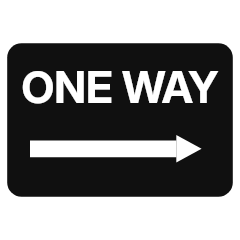
4. A driver on the street this sign governs is preparing to turn left at the next corner. Which lane should the vehicle be in beforehand?
Show answer
Answer A: The lane closest to the left curb
All the traffic here runs the same way, so nothing is coming toward the driver and the turn is taken from the extreme left lane rather than from beside the middle of the roadway.
-
5. How much moving water is generally enough to float and carry away most passenger vehicles?
Show answer
Answer D: About one foot
About a foot of moving water will float most cars, and even less will stall an engine. That is why the rule is to turn around instead of judging the depth.
-
6. A hands free phone conversation is which kind of distraction?
Show answer
Answer C: Cognitive, because your mind leaves the road
Hands free equipment removes the manual and visual parts of a call but not the mental load, and it is the mental load that makes a driver miss hazards.
-
7. The center line beside your lane is a broken yellow line. What does it allow?
Show answer
Answer D: You may cross into the opposing lane to pass when it is safe and clear
A broken yellow center line marks a passing zone where traffic in that direction may cross into the opposing lane to pass when the way ahead is clear.
-
8. In a work zone a flagger is directing traffic in a way that conflicts with the posted signs. Whom do you follow?
Show answer
Answer B: The flagger's directions
A flagger controls traffic through a work area that changes from day to day, and those instructions take precedence over the fixed signs and markings in that zone.
-
9. Loose gravel has been swept into the middle of your lane on a downhill bend. Which controls are affected most?
Show answer
Answer D: Steering and braking, since the loose stones roll under the tires
Gravel rolls between rubber and pavement, so the tires can neither turn the vehicle nor slow it as they would on a clean surface.
-
10. Why should heavy objects in the passenger compartment be secured?
Show answer
Answer A: Because loose objects fly forward in a crash and can injure the people
Anything loose keeps traveling at the speed of the vehicle when the vehicle stops, so it strikes the occupants with great force.
-
11. Two vehicles meet on a steep, narrow mountain road with no room to pass. Which driver should back up?
Show answer
Answer C: The driver heading downhill, who has more control while reversing
On a narrow mountain road the vehicle facing downhill yields, because backing uphill gives better control than reversing down a grade.
-
12. An oncoming driver flashes their headlights while you are waiting to turn left. What should you do?
Show answer
Answer D: Judge the situation yourself, since the flash may mean something else
A flash is not a legal signal and may mean many things, so the decision to turn stays yours and must be based on what you can see.
-
13. You find that your shoulder belt has some slack in it. Why does that matter?
Show answer
Answer D: You travel further before the belt restrains you, so injuries are worse
Slack lets your body build up speed before the belt takes hold, which increases the forces on you and the risk of hitting the interior.
-
14. Besides school signing, which warning signs may also use a fluorescent yellow-green background?
Show answer
Answer C: Pedestrian and bicycle warning signs
Pedestrian crossing, bicycle and playground warning signs may use either the standard yellow or the fluorescent yellow-green background, which draws extra attention where people outside vehicles are present.
-
15. When should you enter a destination into a navigation device?
Show answer
Answer B: Before you start driving, or after parking in a safe place
Programming a route is a visual, manual and mental task at the same time, so it belongs to the moments before the vehicle moves rather than to any point in traffic.
-
16. The school bus stop ahead sign is installed where
Show answer
Answer C: a school bus stop cannot be seen from far enough away by approaching drivers
This school warning sign is used in advance of a bus stop that lacks adequate sight distance and cannot be relocated, so drivers are warned before the stopped bus comes into view.
-
17. How long do points assessed for a moving violation stay on a West Virginia driving record, measured from the conviction date?
Show answer
Answer B: 2 years
Points remain on a West Virginia driving record for two years from the date of conviction.
-
18. You reach an intersection showing a steady red light, and a stop line is painted across your lane. Where must you bring the vehicle to a complete stop?
Show answer
Answer C: Before the stop line
A steady red requires a complete stop before the marked stop line. Where there is no stop line you stop before the crosswalk, and where there is neither, before entering the intersection.
-
19. You leave your car so that its rear overhangs a marked crosswalk. What is wrong with that?
Show answer
Answer B: Pedestrians must step around it into the traffic lane
A crosswalk has to stay completely clear; anything sticking into it pushes people on foot out into the path of moving vehicles.
-
20. Under West Virginia's handbook glossary, what is the maximum horsepower a vehicle's independent power source may produce for that vehicle to still be classified as a moped?
Show answer
Answer B: Two horsepower
The handbook defines a moped as having an independent power source providing a maximum of two horsepower, along with foot pedals for pedaling.
-
21. You are in the acceleration lane and the gap you were aiming for is now beside you. What is the best adjustment?
Show answer
Answer A: Change your speed a little to line up with a gap, then merge smoothly
The acceleration lane is for matching both the speed and the position of a gap, and small speed adjustments are what line the two up.
-
22. What should you avoid when a hostile driver pulls alongside you?
Show answer
Answer A: Making eye contact, or answering the gestures in any way at all
Any response, including a look, encourages an aggressive driver, so give none and let the vehicle go.
-
23. A vehicle in front of you has already begun turning left into a driveway when the gap you were waiting for opens up. What should you do?
Show answer
Answer B: Wait and let that driver finish the turn
A vehicle that has lawfully started a maneuver keeps the right of way until it is finished.
-
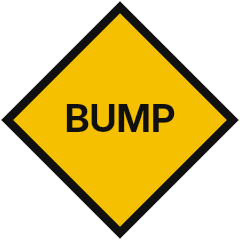
24. Why does this warning matter more on a motorcycle than in a car?
Show answer
Answer B: Because a sudden jolt can unsettle a two-wheeled machine and the rider can lose control
A jolt can push a motorcycle off line or lift a wheel, so a rider slows early, comes slightly off the seat and keeps a relaxed but firm hold on the handlebars.
-
25. Cones and drums mark a shifted lane through a work zone. What should you do?
Show answer
Answer A: Follow the path that they mark and stay inside it
Channelizing devices define the temporary travel path, and the space on the other side of them belongs to the workers.