
West Virginia DMV Permit Practice Test 12
- Questions25
- Correct to pass19
- Passing score76%
- Minimum age15 years
-
1. May you stop briefly across the sloped ramp that joins the sidewalk to the street at a corner?
Show answer
Answer B: No, that ramp must stay clear for people using wheelchairs
A curb ramp is the only way many people can get from the sidewalk to the crosswalk, so blocking it even briefly is prohibited.
-
2. Besides the license suspension and fine, what additional penalty can a West Virginia court impose for a first offense of passing a stopped school bus?
Show answer
Answer D: Confinement in jail for not more than six months
The handbook states a first offense of passing a stopped school bus can also carry confinement in jail for not more than six months, in addition to the suspension and fine.
-
3. You have just had bad news and you feel very upset. What should you do?
Show answer
Answer B: Wait until you have calmed down, or else let somebody else drive
Strong emotion takes attention away from the road as surely as alcohol or fatigue, so it is a reason not to drive yet.
-
4. Four vehicles reach a four-way stop from all four directions at the same instant. How is the deadlock resolved?
Show answer
Answer C: Each driver yields to the vehicle on the right and they go one by one
Yielding to the right applies to every driver, so the group untangles itself as drivers take turns rather than moving together.
-
5. On an undivided two-lane road you meet a school bus coming toward you with its red lights flashing and its stop arm out. What must you do?
Show answer
Answer C: Stop and wait until the red lights stop flashing
On an undivided road drivers in both directions must stop for a school bus loading or unloading, because children may cross in front of it.
-
6. Smoke from a nearby fire is drifting across the highway. What should you do?
Show answer
Answer C: Slow down, use low beams, and close the windows and vents
Smoke cuts visibility like fog and can make your eyes water. Low beams, a much lower speed and closed vents protect both your view and the air in the car.
-
7. A high truck ahead of you hides the traffic signal as you approach the intersection. What should you do?
Show answer
Answer A: Drop back so you can see the signal and the truck's brake lights
Extra following distance restores your view of the signal, so you are reacting to the light yourself rather than copying the truck driver.
-
8. A pedestrian has stepped into a crosswalk at an intersection ahead of you. What is your obligation?
Show answer
Answer C: Yield and let the pedestrian finish crossing before you proceed
Drivers must yield to pedestrians in a crosswalk, and an intersection has a legal crosswalk whether or not lines are painted on the pavement.
-
9. You are first in the queue at a red light with a marked crosswalk. Where should your vehicle stop?
Show answer
Answer A: Behind the stop line, so that the crosswalk stays clear
Stopping short of the line keeps the crosswalk usable for people on foot and keeps your vehicle out of the path of turning traffic.
-
10. In heavy stop-and-go traffic, why does using both lanes right up to a merge point help?
Show answer
Answer D: It stores the queue in two lanes, so the backup is shorter
Filling both lanes halves the length of the queue and keeps it away from the traffic upstream, which is why alternating at the merge point works better when traffic is slow.
-
11. How does a wet road change the distance you need to stop?
Show answer
Answer C: It lengthens it, so you need a much bigger gap ahead
Water between the tire and the road cuts grip, so braking distance grows and the gap that works on dry pavement is no longer enough.
-
12. You reach an intersection with no signs, signals or markings clearly before a vehicle that is approaching on your right. What is the rule?
Show answer
Answer B: You may go first because you got there first
At an uncontrolled intersection the first driver to arrive goes first; the yield to the right rule only settles a tie.
-
13. A grade crossing is marked only with a crossbuck and has no lights or gates. What does the crossbuck require of you?
Show answer
Answer C: Yield to rail traffic and cross only when no train is approaching
The crossbuck requires road users to yield the right-of-way to rail traffic, so you must look and listen and be ready to stop.
-
14. What penalty does West Virginia impose for using someone else's driver's license, letting someone else use yours, or displaying a fictitious license?
Show answer
Answer A: A 90-day license suspension
The handbook states that fraudulent use of a driver's license, including using or displaying a fictitious license, carries a 90-day suspension.
-
15. The vehicle in front of you has stopped and is waiting to turn left, and there is a paved shoulder to the right. May you use it to get by?
Show answer
Answer D: No, in most states a pass may not be made by leaving the paved travel lanes
Passing on the right is normally lawful only inside the marked travel lanes, and most states prohibit driving onto the shoulder to get around a turning vehicle; the few states that allow it attach strict conditions.
-
16. You realize you have driven several miles without remembering any of it. What kind of distraction is this?
Show answer
Answer C: Cognitive distraction, because your mind was not on driving
Daydreaming or being lost in thought is a cognitive distraction. Your eyes may be on the road, but your brain is not processing what they see.
-
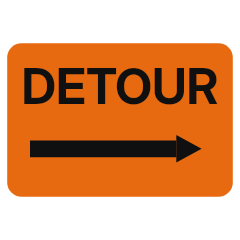
17. Once a driver has joined the route this sign begins, how is the rest of the way marked?
Show answer
Answer B: By further markers of the same kind at each turn, until the original road is rejoined
The alternate route is signed continuously, with a marker at every turn, so a driver with no local knowledge can follow it back to the original road.
-
18. You are leaving a freeway on an exit ramp posted with an advisory speed of 25 mph. Where should you slow to that speed?
Show answer
Answer A: In the deceleration lane, before you reach the curve of the ramp
Slowing belongs in the deceleration lane so you arrive at the curve already at the advisory speed and do not hold up traffic still in the through lanes.
-
19. What does the solid white line running along the right side of a highway mark?
Show answer
Answer A: The right edge of the traveled way
A solid white edge line shows where the traveled way ends on the right, which is particularly useful at night and in poor visibility.
-
20. You and an opposing driver reach a four-way stop at the same time and both of you are turning right. What should happen?
Show answer
Answer C: Both may turn at the same time into their own lanes
Two opposing right turns take drivers into different lanes without crossing, so both can proceed together once pedestrians are clear.
-
21. Once you are moving, which way of using a navigation device costs you the least attention?
Show answer
Answer B: Listening to the spoken directions
Voice guidance lets you keep your eyes on the road, while anything that needs the screen takes glances that add up over a trip.
-
22. You are the first to arrive at a crash on a rural road. What should you do first?
Show answer
Answer C: Park well clear of the scene, put on your hazard lights and call for help
Getting trained help on the way and keeping the scene visible does more good than anything an untrained bystander can do.
-
23. You feel dizzy and get a headache while driving with the windows closed. What could be the cause and what should you do?
Show answer
Answer D: An exhaust leak letting carbon monoxide into the cabin, so open the windows and stop to get fresh air
Carbon monoxide is colorless and odorless, and headache, dizziness and drowsiness are early signs. Get fresh air at once and have the exhaust system inspected.
-
24. How does a lap and shoulder belt protect you in a crash?
Show answer
Answer B: It holds you to the seat and spreads the force over the strong bones
The belt keeps you with the vehicle as it slows and puts the load on the hips and the chest rather than on soft tissue.
-
25. You have just been involved in a crash on a city street. Which sequence of first steps is correct?
Show answer
Answer A: Stop where you are, check everyone for injuries, and then make the scene safe
You are required to stop, and the first priority at the scene is people, followed by preventing a second collision.